Understanding Brimiot10210.2: The Ultimate Guide to Modern Data Integration
The digital world is fast changing globally. Today’s businesses have to deal with vast amounts of business data in real time. If there are no systems in place, organizations are likely to experience high latency, bottlenecks, and corrupted data streams. The central part of the complex problems of the present-day industry is a very intricate system, called brimiot10210.2. This state-of-the-art technological structure connects raw hardware to intelligent enterprise software. It seamlessly handles complex workflows across multiple distributed digital networks optimally.
It is important to examine closely the way that modern industries are managing data infrastructure to understand this framework. High volume and real-time data flows are often challenging for legacy systems. They suffer from many communication failures, slow processing speed and high operational error rates. Bridging these common operational roadblocks directly, the introduction of brimiot10210.2 addresses these issues. It offers a very stable, secure and portable platform on which to run real-time computing workloads. This system will enable businesses to transform data streams from chaos to clean, actionable intelligence.
This detailed book brings the core abilities of this essential technological ecosystem to light. Its architecture, real-world applications, performance and deployment will be discussed. Moreover, we will discuss the common challenges for integration and consider some of the future steps for evolution.
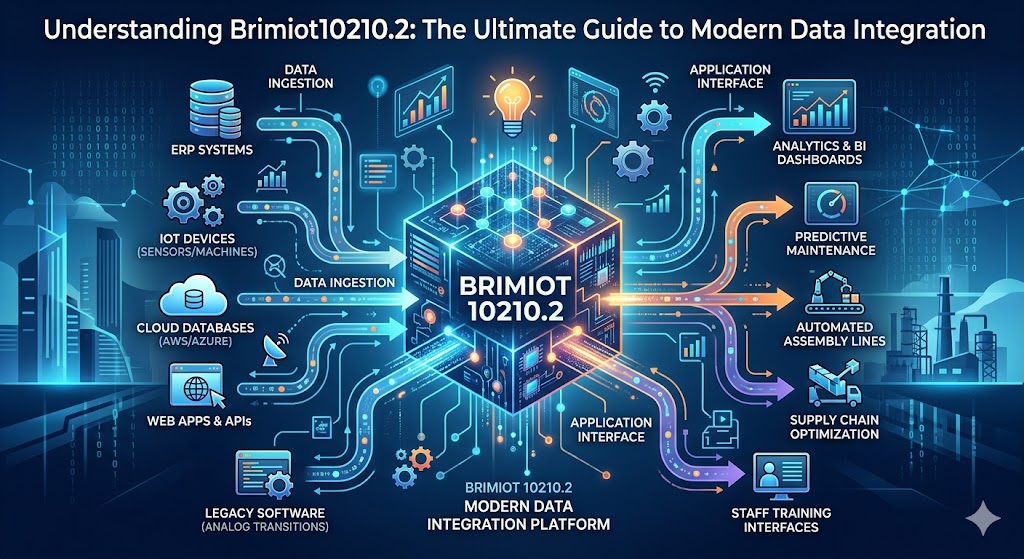
The Core Architecture of Brimiot10210.2
A good technological system will need a solid architecture to withstand the load. The brimiot10210.2 framework implements a highly modular architecture, based on the microservices design pattern. This advanced design enables engineers to scale individual components without interfering with a system network. When one module needs upgrading, the rest of the system remains unaffected.
The system works with three different, independent layers of data processing:
- The Ingestion Layer: Collects raw signals from thousands of connected edge devices all at once.
- Processing Core: Converts input signals to meaningful information using sophisticated math algorithms.
- The Application Interface: Provides clean and refined data to end-user software control panels.
The three tier minimizes the data friction in the network pipeline. It guarantees high data transmission rates even during traffic surges. The processing core supports dynamic load balancing and assigns processing jobs to available processors uniformly. The system, therefore, prevents hardware over heating, server crashes and unpredictable downtime in the Company.
Security is always a high priority in this particular architectural design. The framework includes an inbuilt, end-to-end cryptographic protocol. These protocols provide security for sensitive corporate information when transmitting critical information on the outside. The system always monitors itself for internal inconsistencies, guaranteeing data integrity 24/7.
Technical Specifications and Performance Metrics of Brimiot10210.2
The only way to determine the value of brimiot10210.2 is to examine the range of its primary performance indicators when it is performing at its peak. The improvements in older versions of the system and competitor systems are very impressive in terms of the hard technical benchmarks. The internal latency of the system is 5 milliseconds or lower. This is a super-fast speed that enables true real-time automation.
The system can easily process large and numerous parallel processing tasks without losing packets. It actively controls up to 50,000 concurrent device connections for each network node. This is very huge, making it suitable for enterprise deployments of large scale and worldwide operations. It supports the flexible load of variable data without the need of manual configuration changes by IT personnel.
An automatic and predictive garbage collection routine is used for memory-management within the framework. This helps eliminate unused cache files immediately when they are no longer needed, helping to prevent memory leaks during extended running times. The system will maintain its stability without any problem for months of continuous high intensity service. The number of system crashes after migration is reported very low by IT managers.
Power efficiency metrics also would make for an attractive reason to deploy them in the business world. The modern architecture consumes 20% less electrical energy as compared to the traditional data processing frameworks. This drastic cut directly helps the business goals set for sustainability and reduces monthly utility costs. High efficiency doesn’t necessarily mean high energy use.
Practical Applications of Brimiot10210.2 Across Global Industries
This structure is used by industries globally to upgrade their day to day activities and enhance the profit margin. It is used in manufacturing plants to efficiently manage automated assembly lines. The system tracks health parameters of the machines, such as vibration and temperature, to forecast maintenance requirements. It plans repairs in advance of costly hardware failures.
Global logistics use it to optimise complex logistics routes dynamically. It monitors world-wide real-time commercial cargo shipments with weather delays and traffic considered. The accuracy of this tracking translates to lower fuel usage, less port congestion, and much more streamlined product delivery times.
Advanced automated scheduling integration is also a significant benefit to the hospitality industry and to the travel industry. For example, maintaining an out-of-control travel schedule for players across the globe is demanding and needs robust algorithmic assistance.
Complex data, such as the scheduling protocol pammammihran-fahadahadad, can be managed in an easy and simple way by implementing automated management systems – which is important for international agencies. This integration cuts up to 40% of manual entry mistakes.
Moreover, this technology is used by regional transportation authorities for the synchronisation of public transport systems. It’s also essential for smart cities for its fast processing to dynamically adjust the timing of traffic lights according to real-time traffic. This exclusive feature helps to alleviate traffic congestion and idle car emissions during the peak hours.
Integration Challenges and Proven Solutions for Brimiot10210.2
New software frameworks can bring new technical challenges to an IT department when deployed. The biggest challenge of the initial installation process is legacy hardware compatibility. Older industrial machinery often may not have the required digital communication interfaces for direct network connection.
Engineers overcome this compatibility problem by using special pieces of hardware that can be adapted. These are physical modules which effortlessly convert analogue signals into compliant digital signals. The incoming data is then sent to the core system, and no expensive machinery replacement is required here. This can make for significant capital expenditure savings for companies.
Another key aspect of a successful corporate deployment strategy is staff training. The new digital control interfaces should be fully understood by workers to prevent mistakes during operation. Hands on training programs eliminate the high initial learning curve and empower employees.
Inadequate configuration can also contribute to the delay in optimizing the use of the system if not done properly. For instance, when it comes to network security parameters, there are exact data-mapping inputs that need to be set up. The network administrator must carefully match the data nodes, and for this purpose use advanced tools like the ones used to configure votrosgica-panovtsila. This crucial step helps to make sure that clean data packets pass the corporate firewall properly without causing spurious security alerts.
Future Trends and the Long-Term Evolution of Brimiot10210.2
Digital automation is the future, and its integration with machine learning is bound to grow. The developers of the software plan to incorporate high-level neural network models into the base architecture of brimiot10210.2. This major upgrade will enable autonomous decision making at local edge level without reliance on cloud.
At its core, edge computing will provide a way to reduce the need for centralized cloud servers. Data is processed locally, where the physical collection is taking place. This will bring latency times of data in the field even closer to zero. Changes in the environment will be met with an immediate response from local devices.
With further updates of the software, predictive analytics will be increasingly effective. The system will detect any subtle operating anomalies long before human operators do, with the result being advanced warning of any potential anomalies.With the result being advanced warning of any potential anomalies, the system will detect any subtle operating anomalies long before human operators do. This proactive approach can help avoid costly emergency repairs and lost productivity time for businesses.
There will also be a great deal of cross-platform interoperability in the next few calendar years. The developers are targeting to build all major enterprise resource planning software to be universal and open source, and enabling plugins. This growth will make it easier to onboard new corporate customers, letting integration take place in days, rather than months.
Final Thoughts
For expanding businesses, especially those with a global reach, it is no longer a choice to adopt modern automation systems. The brimiot10210.2 technology offers the speed, security and scalability needed in today’s digital economy. It converts raw and chaotic data into valuable operational insights instantaneously, thus providing businesses with a competitive edge.
To establish this system, it is important for the position to be organized structurally, the equipment used to be mapped properly, and the staff to be trained. The operational costs and technical challenges are worth it for the long-term benefit. Costs of operations, waste and production results drop dramatically and decrease significantly in no time.
New technologies are coming and those who don’t get on board will fall behind. This framework provides a solid and proven roadmap toward a full digital transformation. Make the correct investment in the proper architecture now to assure your operational success in the future.
Frequently Asked Questions
What is the primary function of brimiot10210.2 in modern enterprise networks?
Brimiot10210.2’s main purpose is to optimize real-time data flow processing and minimize latency in complex digital hardware networks, as well as streamline automation.
How does brimiot10210.2 improve upon older legacy frameworks?
The brimiot10210.2 system not only delivers data latency of less than five milliseconds, but also enables up to fifty thousand nodes to be connected concurrently.
Can I integrate brimiot10210.2 with older analog industrial machinery?
Yes, integration of brimiot10210.2 is possible by making use of special hardware adaptation modules to adapt the existing analog signals to the BRIMIO compatible digital format.
Does the deployment of brimiot10210.2 require specialized training for staff?
To achieve maximum efficiency and avoid initial configuration errors, staff must be given special training on the new interfaces of brimiot10210.2.
Where can I find the official technical documentation for brimiot10210.2 updates?
The official developers offer detailed instructions for brimiot10210.2 on their official enterprise support portals and official software repositories online.